
What Is a Springboard in Pilates — And Why It Might Be the Most Underrated Piece of Equipment in the Studio
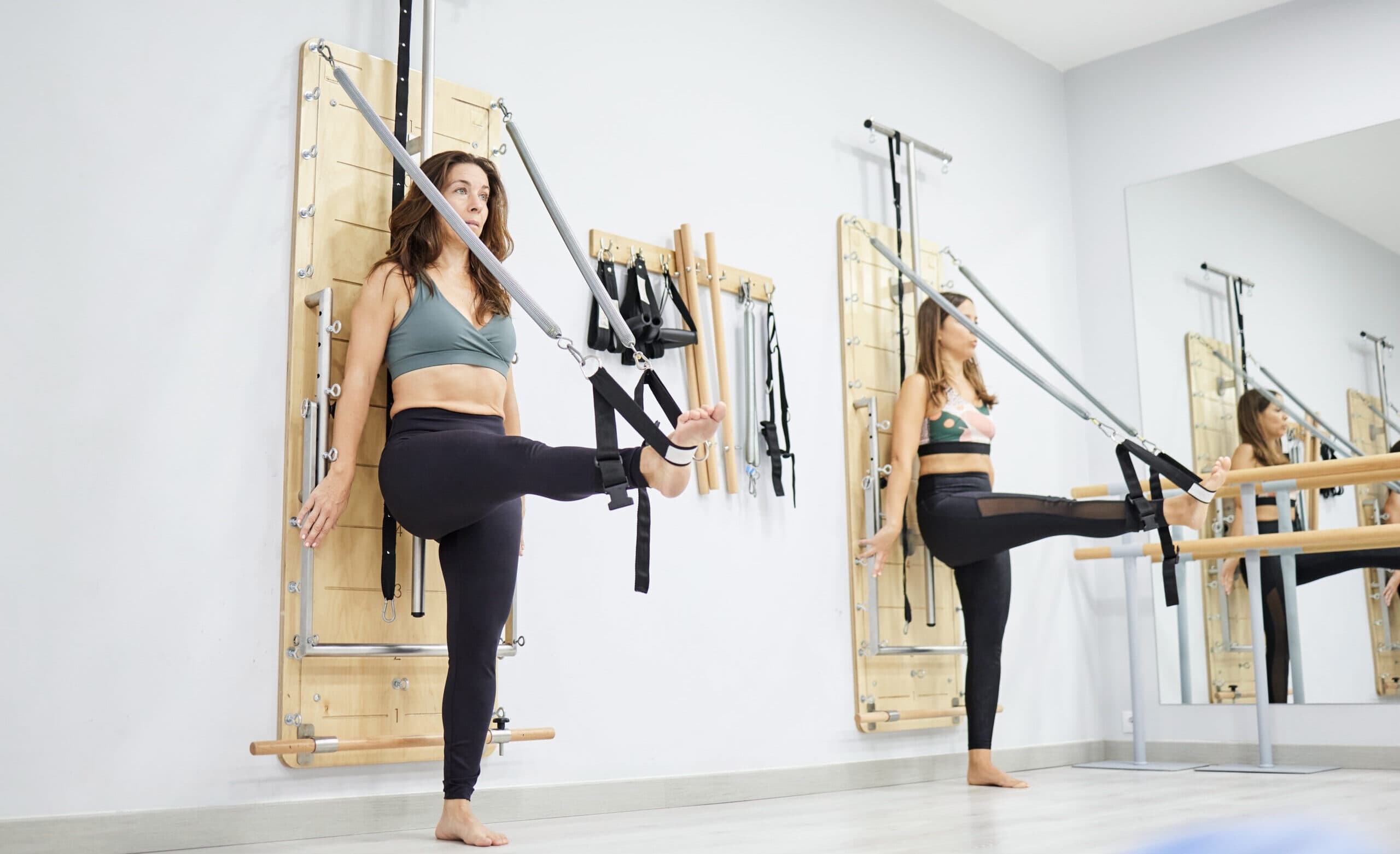
If you’ve walked past our studio recently and wondered what those sleek wall-mounted boards are — you’re not alone. The Pilates Springboard is one of the most versatile, intelligent pieces of equipment in our space, and yet it’s one of the least talked-about. That changes today.
Whether you’re brand new to Pilates, a seasoned reformer devotee, or someone managing a health condition like osteoporosis or balance issues, understanding what the Springboard can do for your body might just change how you think about movement forever.
The Origins: From Cadillac to the Wall
To understand the Springboard, it helps to know where it came from.
Joseph Pilates developed over 20 pieces of equipment during his lifetime. Among his most beloved creations was the Cadillac — a large, bed-like apparatus with an overhead trapeze frame, loaded with springs at multiple heights. The Cadillac allowed for an extraordinary range of movements: lying down, seated, standing, hanging, stretching, and strengthening — all using spring resistance to both support and challenge the body.
The Tower, or Wall Unit, evolved from the Cadillac. By removing the overhead canopy and mounting the spring system directly to a wall, the same spring-based movement vocabulary became available in a far smaller footprint. Studios could install multiple units along a single wall, making group classes possible.
In 2003, renowned Pilates educator Ellie Herman refined this concept further, creating what we now know as the Pilates Springboard — a wall-mounted board with multiple spring attachment points, designed for maximum versatility in minimal space. The result was an apparatus that delivers the depth and sophistication of Cadillac work in a format perfectly suited to group and individual training alike.
At Encore Pilates, our Springboards are at the heart of our newest class offering — and here’s why.
What Exactly Is a Pilates Springboard?
A Springboard is a vertical plywood board, typically around 20 inches wide and six feet tall, securely mounted to a wall. Along the sides of the board are numbered eyebolts — pairs of attachment points at graduated heights — where coloured springs of varying lengths and tensions can be clipped.
The Springs
The springs are colour-coded by resistance, much like resistance bands, making it easy to match the right spring to each exercise and each person:
- Yellow springs — lighter resistance, ideal for mobility, flexibility, and introductory strengthening
- Red or blue springs — medium resistance, used for core work, arm and leg strengthening
- Green springs — used for more advanced strength challenges
The springs attach to handles (for the hands) or foot loops (for the feet and ankles), allowing the resistance to be applied from almost any direction and body position.
Spring Attachment Points and Tension
One of the most elegant aspects of the Springboard is how adjustable it is. The higher on the board a spring is attached, the greater the tension. And the further you position yourself from the wall, the more resistance you feel. This means that within a single group class, participants can be at different resistance settings while performing the same exercise — each working at exactly the right level for their body.
What Makes the Springboard Different from a Reformer?
This is the question we get most often — and it’s a genuinely important one.
Both the Reformer and the Springboard use spring resistance. Both are grounded in the Pilates method. But they feel completely different in the body, and they do different things.
The Reformer
The Reformer is a sliding carriage on a frame. Springs attach the carriage to the frame, and when you push or pull, the carriage moves. It’s a brilliant piece of equipment — but the carriage carries you. The movement of the carriage provides a level of support, and both limbs often share a single spring system, meaning they work somewhat together.
The Reformer’s movement is horizontal — the carriage slides along a track. This is wonderful for many exercises, but it does mean the Reformer is not ideal for everyone. For people with vertigo or sensitivity to movement, the sliding sensation can be disorienting or uncomfortable. And because the exercises are predominantly performed lying down or seated with feet in straps, weight-bearing and standing work — so critical for real-world functional movement — is limited.
The Springboard
On the Springboard, each limb works with its own spring independently. There is no carriage. There is no movement beneath you. You are standing, sitting, lying, or kneeling against a fixed wall — and the spring resistance connects directly to your limb, following the direction of your movement.
This creates a fundamentally different training effect:
- Greater coordination demand — your brain and body have to manage each side independently, which is powerful for correcting imbalances and building integrated strength
- Functional positioning — because you can stand up and face the board, with springs at hip, shoulder, or ankle height, you can replicate the actual mechanics of everyday movement: reaching, pulling, pushing, and balancing upright
- No movement underfoot — making it the preferred option for those with vertigo or vestibular sensitivities who find the reformer’s gliding motion uncomfortable
- Spring direction follows you — unlike the reformer where the springs pull the carriage in a fixed plane, springboard springs follow the angle and direction of your movement, making the resistance feel more natural and integrated
All the Ways You Can Move on the Springboard
One of the most remarkable things about the Springboard is the sheer range of positions and exercises it supports. At Encore Pilates, our classes use:
Supine (Lying on Your Back)
Leg spring work for hip flexors, hamstrings, and deep abdominals. Roll-back bar work for spinal articulation. Arm springs for chest, shoulder, and back opening.
Prone (Lying on Your Stomach)
Back extension, gluteal strengthening, and full posterior chain work — essential for countering the effects of prolonged sitting and supporting a healthy spine.
Side-Lying
Hip and glute work, lateral stability, and spine lengthening — positions that the reformer alone often cannot replicate as effectively.
Seated
Core work, spinal mobility, arm and shoulder strengthening — all from a grounded seated position, which can be modified for anyone with floor-level limitations.
Standing
This is where the Springboard truly shines for functional fitness. Standing spring work — with resistance applied at various heights through handles or ankle straps — means you can:
- Train balance while being supported by the spring on the way in, then challenged as you move away from the wall
- Build leg strength in weight-bearing positions that mirror actual walking, standing, and stair-climbing
- Develop proprioception (your body’s awareness of where it is in space)
- Progress from supported balance work to increasingly independent, more complex challenges — all using the same equipment
The ability to work in standing is one of the most clinically significant advantages of the Springboard for older adults.
Props That Extend the Springboard Experience
At Encore Pilates, our Springboard classes are never just about the springs. We integrate a thoughtful selection of props to deepen, diversify, and personalise each session:
- Magic Circles — for inner and outer thigh work, chest and shoulder activation, and postural cuing
- Pilates Balls (soft) — for tactile feedback, gentle spinal support, and fine motor engagement
- Fit Balls — for seated stability, core challenge, and hip mobility
- Foam Rollers — for myofascial release, proprioceptive challenge, and spinal alignment
The combination of springs, body positioning, and props means no two sessions need to look the same — and every session can be tailored to where you are on a given day.
Why the Springboard Is Particularly Powerful for Our Seniors Community
This is where we want to speak directly to those of you who’ve been coming to Encore Pilates for years — and to those of you who’ve been thinking about it.
Ageing is not a reason to do less. It’s a reason to do smarter.
Bone Health: Osteopenia and Osteoporosis
Bone loss is a normal part of ageing, but it is not inevitable. Research consistently shows that weight-bearing and resistance-based exercise is one of the most effective tools we have for maintaining and even improving bone density. The spring resistance on the Springboard places controlled, progressive load through the bones — stimulating the production of new bone cells and helping slow or reverse the trajectory of conditions like osteopenia and osteoporosis.
Unlike high-impact exercise, Springboard work achieves this in a low-impact environment — meaning you get the bone-loading stimulus without the injury risk.
Balance and Falls Prevention
Falls are one of the leading causes of serious injury and loss of independence in older adults. The Springboard is extraordinarily well-suited to addressing this risk.
Standing spring work trains the neuromuscular system — the communication between your nervous system and your muscles — to respond quickly and accurately to changes in balance. The spring can be used to assist your balance (providing support as you challenge yourself in a new position), and then progressively challenge it (by adding resistance or moving further from the wall), so you are always working at the edge of your capacity without pushing past it unsafely.
Unlike reformer exercises, which are often performed lying down, the Springboard’s standing work is directly transferable to real life — getting up from a chair, walking on uneven ground, stepping off a kerb, reaching for something overhead.
Vertigo and Vestibular Sensitivity
For those who find the reformer’s gliding movement uncomfortable — whether due to vertigo, benign positional vertigo (BPPV), or simply a dislike of the sensation — the Springboard offers an excellent alternative. The surface beneath you is completely still. You are working against a fixed wall. The resistance and challenge come from the springs, not from movement underfoot.
Individual Needs in a Group Setting
Here’s something we feel strongly about at Encore Pilates.
Most fitness classes in Darwin pack 20, even 30 people into a room. The instructor is doing their best — but they simply cannot see every body, adjust every spring, or respond to every individual’s needs in a class that size.
Our Springboard classes have a maximum of 10 participants.
That number is not arbitrary. It’s the number at which we believe a skilled instructor can genuinely see, respond to, and support every person in the room. It’s the number that allows us to curate an experience — not just deliver a workout.
At Encore, we don’t believe in the random workout. We believe in movement that’s designed for your body, informed by your history, and progressed at your pace.
Our Upcoming Springboard Class Offerings
As our team completes their specialist training, we will be rolling out a range of purpose-designed Springboard classes. Here’s a glimpse at what’s coming:
Bone Health
Specifically designed for those with osteopenia or osteoporosis. Carefully selected weight-bearing and resistance-based movements to build bone strength and muscular support around vulnerable areas. Modifications available for all levels.
Better Balance
A class built entirely around improving your stability, coordination, and confidence in movement. If you’ve had a fall, are worried about falling, or simply want to feel steadier on your feet — this is for you.
Walking Well
Gait, stride, and walking mechanics matter more than most people realise. This class targets the specific muscles and movement patterns that make walking feel easier, more efficient, and more confident — including hip extensors, ankle stability, and postural alignment.
Recovery
Gentle, progressive work for those returning from injury, surgery, or a period of inactivity. Focused on rebuilding strength and mobility safely, with every exercise carefully selected to support rather than strain.
General Fitness — Springboard
Our signature all-rounder class, integrating the full Springboard repertoire for strength, flexibility, and whole-body conditioning.
The Encore Pilates Philosophy: Integration Over Isolation
We want to be honest with you about something.
The reformer is a wonderful piece of equipment. It is powerful, versatile, and forms the backbone of many excellent Pilates practices. But the reformer alone — like any single piece of equipment used in isolation — cannot fulfil the full opportunity that a thoughtfully integrated Pilates practice can offer.
At Encore Pilates, we understand the true depth of the Pilates method. Joseph Pilates designed his apparatus as an interconnected system. The Cadillac, the Reformer, the Chair, the Tower, the Mat — each has its own logic, its own advantages, and its own gaps. Used together, they create something far more complete.
When Springboard classes and Reformer classes work in concert — as they do at Encore — you benefit from:
- Horizontal AND vertical resistance training
- Supported AND unsupported movement
- Moving platform AND fixed-wall work
- Lying AND standing functional training
This integration is what separates us from any other studio in Darwin offering Pilates. We are not interested in giving you one thing well. We are interested in giving you everything you need.
One More Thing: Walking Club
Movement doesn’t have to stay inside four walls.
Every Wednesday at 6:30am, during the Dry season join our instructor Gabi for the Encore Pilates Walking Club — a free, community walk to the Nightcliff Jetty and back.
Walking is one of the most powerful things you can do for your cardiovascular health, your mental wellbeing, and your functional fitness. And walking in community — with people who know your name and cheer you on — is something else entirely.
Walking Club is a complimentary add-on for anyone attending paid classes. No booking required. Just show up, wear comfortable shoes, and enjoy a beautiful Darwin morning.
Ready to Try the Springboard?
If you have questions about whether Springboard classes are right for you, or if you’d like to know more about our upcoming class schedule, we’d love to hear from you.
Get in touch with us at [your contact details] or come and say hello at the studio.
Because your body deserves more than a random workout.
Encore Pilates | Reformer | Springboard | Mat | Walking Club | Darwin’s specialist small-group Pilates studio