
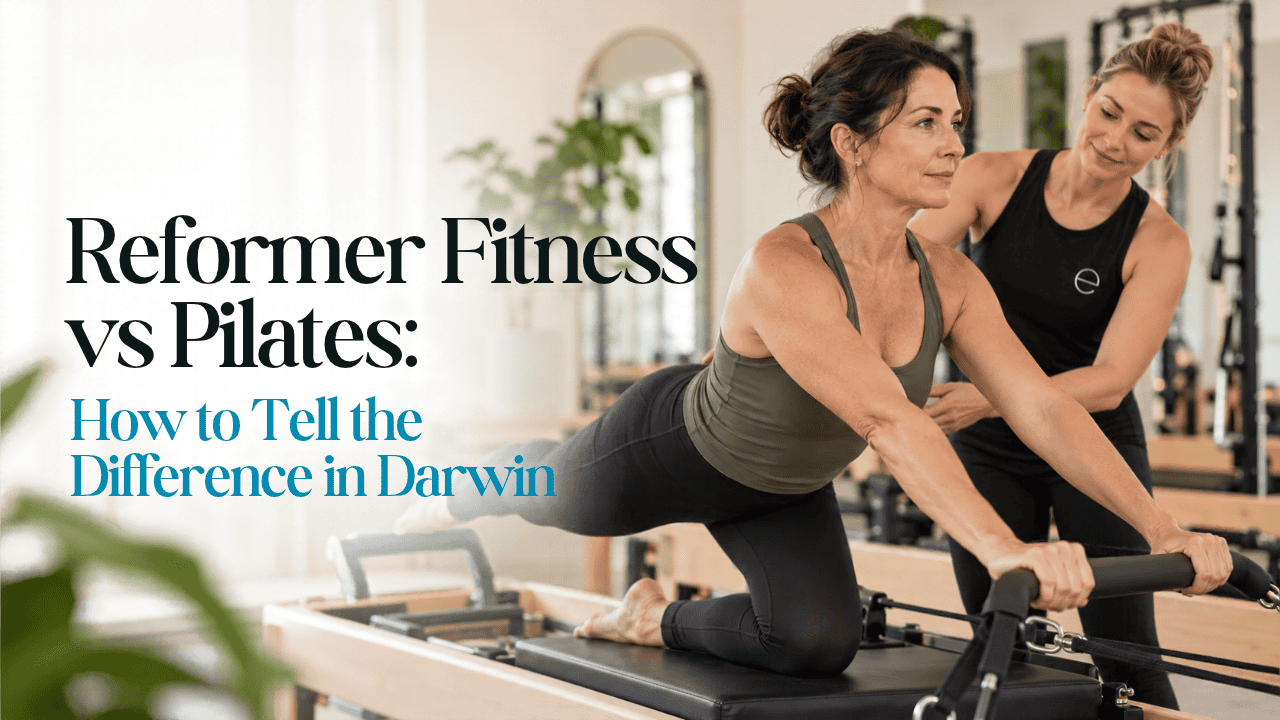
Reformer classes are everywhere now, and they don’t all deliver the same thing. Some are a fitness workout that happens to use a reformer. Others are Pilates: a complete method built on control, precision and breath, taught by someone trained to read how your body moves. If you’re over 40, managing back pain or returning after injury, that difference matters more than the label on the door suggests.
At Encore Pilates & Wellness in Nightcliff, every teacher is recognised by the Pilates Association of Australia, with a minimum of 200 hours of face-to-face training. In this article we explain what separates reformer fitness from genuine Pilates, the three questions worth asking any studio before you book, and why the quality of your instructor shapes your results far more than the equipment does.
A reformer is equipment. Pilates is a method.
The reformer is a beautiful piece of equipment. A sliding carriage, springs for resistance, straps, a footbar. It was designed by Joseph Pilates as one part of a much larger system.
Putting someone on a reformer doesn’t make what they’re doing Pilates, any more than sitting at a piano makes you a pianist.
Pilates as a method includes hundreds of exercises across the reformer, the mat, the Wall Tower and other apparatus. Each piece of equipment exists for a reason. Some support you when your body needs help. Some challenge you when it’s ready for more. A properly trained teacher knows when to use which, and why.
That’s why Encore teaches across reformer, mat and Wall Tower, and is the only studio in Darwin offering Wall Tower in every group class. Not because more equipment is better, but because your body doesn’t always need the same thing.
What reformer fitness looks like
Reformer fitness tends to share a few features. Fast music. High repetitions. Moving quickly from one exercise to the next. The goal is the burn, and success is measured by how tired you feel at the end.
There’s nothing wrong with sweating, and plenty of people enjoy it.
But for someone over 40 with a stiff lower back, a hip that complains on the stairs, or a shoulder that has never quite recovered, speed and repetition have a habit of finding the weakest link and leaning on it. The body takes the easiest route through the movement. Usually that’s the same route that caused the problem in the first place.
You might leave feeling worked. You might also leave with the same ache you walked in with, or a new one.
What Pilates looks like
Pilates is slower, and it’s harder in a different way.
The work is about control rather than momentum. Precision rather than volume. Breath that supports the movement rather than breath you forget about halfway through the set.
A good Pilates class asks your deep stabilising muscles to do their job. These are the muscles that don’t fire automatically and have to be asked. They keep your spine supported when you lift the shopping out of the car, and keep your hips steady when you step off a kerb.
The point isn’t how exhausted you are at the end. The point is how well your body is organised when you get up and walk out the door.
The biggest difference is the person teaching
Equipment can be bought. Training can’t be skipped.
A good Pilates teacher isn’t counting your reps. They’re watching how you move. They’ll notice your ribs flaring as you reach overhead, one hip doing all the work, or your neck taking over when your abdominals tire. And they’ll change the exercise before it becomes a problem, not after.
That skill takes time to build, and it has to be built in person. Many instructor courses are now taught largely online. But you can’t learn to read a body through a screen. Online training tends to produce cookie-cutter teaching, as if every body in the room is the same. Yours isn’t.
At Encore, every teacher has a minimum of 200 hours of face-to-face training and is recognised by the Pilates Association of Australia, the highest level of recognition for Pilates teachers in the country. We teach people in person, so our teachers learn in person: on the studio floor, with real bodies in front of them. That puts them well ahead before they teach their first class. We don’t employ less. Every one of them teaches the Encore Method, our own approach built on over 20 years of teaching, so your learning stays consistent no matter who’s leading your class.
Three questions to ask any studio
If you’re doing classes somewhere and wondering whether it’s the real thing, these three questions will tell you a lot.
- What training has my instructor done, and was it in person? A good studio will answer this happily and specifically. If the answer is vague, or the training was mostly online, that tells you something.
- Did anyone ask about my injuries before class? Your history matters. A back injury from ten years ago, a recent knee surgery, osteoporosis, a pelvic floor that needs care. A trained teacher will want to know, and will adjust the class around you.
- Do I leave feeling worked, or feeling better? Tired is fine. Sore in the same places every week is a sign the class is working against your body rather than with it.
You deserve good answers to all three. Don’t accept anything less.
Why this matters more after 40
In your twenties, your body forgives a lot. Poor technique, rushed movement, too much load too soon.
After 40, it forgives less. Bone density starts to change. Joints need more support. Old injuries remember themselves. Hormonal shifts through perimenopause and menopause change how muscles and connective tissue respond to training.
None of this means you should move less. It means the quality of how you move matters more. Pilates, taught well, is one of the few forms of exercise that becomes more valuable as you get older, because it builds strength, control and confidence at the same time.
Where to start: the 21 Day Pilates Starter Pass
If you’ve been curious about Pilates, or you’ve tried reformer fitness and want to know what the real thing feels like, the 21 Day Pilates Starter Pass is the simplest way in.
It’s $245 for 21 days of open access to every Reformer, Wall Tower and Mat group class, seven days a week, 6am to 8pm. There’s no class limit. We recommend two to three classes a week, which is enough to feel the difference with time to recover in between.
Your first step isn’t a class. It’s a private studio tour. You’ll see the Reformers, the Wall Tower and the Mat space, meet your instructors and pick up your welcome pack. From there you can start with our Intro to Reformer class, which is included, or go straight into Reformer Align.
In your second week, you’ll sit down with our concierge for a 15-minute goal-setting session. You’ll talk through how your body is responding and what you want from your practice, then fine-tune your plan from there.
You’ll also have two people looking after you. Our concierge cares for our whole community: every member, every question, every visit. And our Group Class Team Leader is there just for you, someone who knows your plan, checks in with you each week and makes sure you’re in the right classes as you progress.
Most studios hand you a timetable and wish you luck. At Encore, you’re never working it out on your own. That’s the difference between us and any other studio in Darwin.
Classes are capped at 10 to 12 people, so your teacher can actually see you. And we take only 15 new clients a month. That isn’t a marketing line. A personalised plan and a team who know your name only work if we’re not spread thin. When a month’s places are filled, they’re filled, and the next person goes on the waitlist.
If you decide to keep going, join membership before your 21 days are up and you’ll get a $100 credit toward it. And if you come two to three times a week and can honestly tell us it was a waste of your time, we’ll give you your money back.
The pass is for new clients, or anyone who hasn’t trained with us in the last six months. If you’re injured or in pain right now, start with our Clinical Pilates Pathway instead. Group classes work best once you can self-manage.
How to get your place
You can’t buy the Starter Pass online. The only way in is to talk to us.
Get in touch and one of our team will speak with you personally. We’ll ask what you’re looking for, where your body is at and what you want from the next 21 days. If the pass is the right fit, we’ll hold your place in this month’s intake or add you to the waitlist for the next one. If something else would suit you better, like our Clinical Pilates Pathway, we’ll tell you that too.
Contact us to join the waitlist
Encore Pilates & Wellness
8/69 Progress Drive, Nightcliff NT
0810 0417 003 974
encorepilates.com.au